Seifert Subsurface Understanding, LLC
In Petroleum Engineering Subsurface Development, it is common to evaluate a project with a range of uncertainty. Typical projects may be planning an infill oil producer, planning water injectors, evaluating a waterflood conversion, or designing a full field development.
Rather than deterministic Low-Mid-High ranges, we often deploy probabilistic evaluation using Monte Carlo based methods or more complex and time consuming full 3D static/dynamic modeling methods (Integrated Reservoir Modeling – IRM).
After extensive modeling and analysis, a P50 outcome is derived plus a P90-P10 outcome range. The project is then economically evaluated against the P50 and P90 outcomes and sanctioned if deemed economically robust against these proposed outcomes.
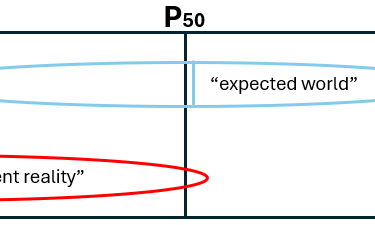
Thinking of a portfolio of sanctioned projects, it is expected that (a) about 80% of the outcomes fall inside the range, (b) most projects cluster around the P50, with (c) few projects approaching both the P90 and P10 outcomes (blue ellipsoid in Figure).
Figure: Project outcomes vs. P90, P50 and P10 expectations.
Reality, however, is often quite different (red ellipsoid in Figure). It can be observed that (a) projects tend to cluster somewhat below the P50 outcome, with (b) a further skew towards the lower quartile, and (c) only a very small number of projects being significantly better than the P50. Finally, of the projects that fall outside the range, the vast majority are below P90. Extreme outcomes are possible on either side.
This has puzzled leaders for some time, because staff have generally been doing great technical work and been following the technical standards. We know that the main reasons for this are that either (a) hydrocarbon volumes in place (HIIP) are below expectation, (b) recoverable volumes are much lower than expected or (c) recovery of the recoverable volumes requires many more wells and time due to much greater complexity. While we got better in the industry at predicting static volumes (HIIP), total project performance often remains below P50. It should be noted that in reservoir development circumstances where we can drill many wells cheaply and quickly, project outcomes tend to approach a ‘more expected world’ result.
Why is that?
In my opinion, the main reasons for this are:
Reservoirs are much more complex than we give them credit for. We fail to build a proper understanding of the subsurface, due to inefficient integration processes and early anchoring on a “best technical estimate” case (BTE). An outcome much below the P50 may not be a pessimistic outcome, but a P50 outcome of an alternative scenario with its own and independent distribution curve.
Solutions: build a better/deeper understanding of the reservoirs including considering alternative scenarios and screen them vs. project parameters.
Once entering more complex modeling stages, deploy decision-based IRM methods.
Success bias, we get paid to make projects go and under time pressure often fail to look at alternate outcomes in sufficient detail or have no viable backup plan.
Solution: build thorough subsurface understanding for entire team, incl. use of analogs and benchmarking.
Clearly define, document and communicate risks through better assurance questioning and specific documents focusing on such aspects.
Develop and ‘stress test’ a backup plan if a risk is realized (…which is not the Low Case!).
Project studies often take too long, because we focus on complex modeling too early and are then not prepared to significantly change tack when problems arise and often rationalize or dismiss negative information.
Solution: use truly integrated workshops to build a team-wide deep understanding of the reservoir quickly, use analytical or simple modeling tools to evaluate and screen models and scenarios.
Go to detailed static/dynamic modeling (IRM) only when necessary and deploy decision-based IRM and multi-scenario modeling.
Note: this amounts to a change in the way we work in subsurface!
What does Seifert Subsurface Understanding, LLC bring to help with such matters?
Understanding and communicating all the issues mentioned above.
For any project, emphasize multi-scenario evaluation and better subsurface understanding before embarking on longer studies (including IRM). Help change the “way of working” to steer away from complex modeling by default and focus on answers using “back-to-basics” analytical PE tools.
As SME for IRM, bring focus to Decision-Based Integrated Reservoir Modeling (DB-IRM) and Multi-Scenario Modeling, when static/dynamic modeling is needed.
Insist on better handling of key issues, e.g., focus on truly integrated questions and emphasizing uncertainties, risks and benchmarking. Bring those topics into technical work and communication to leaders (incl. assurance review or reviews of FDP). Help create targeted documents for risk and uncertainty communication if necessary.
Increase better subsurface understanding through ‘true integration’, e.g., by leading workshops.
Support screening of opportunities for portfolio ranking (e.g., through screening workshops using analytical modeling).
***subsurface understanding avoids overspending***
Add'l Thoughts Fewer Staff